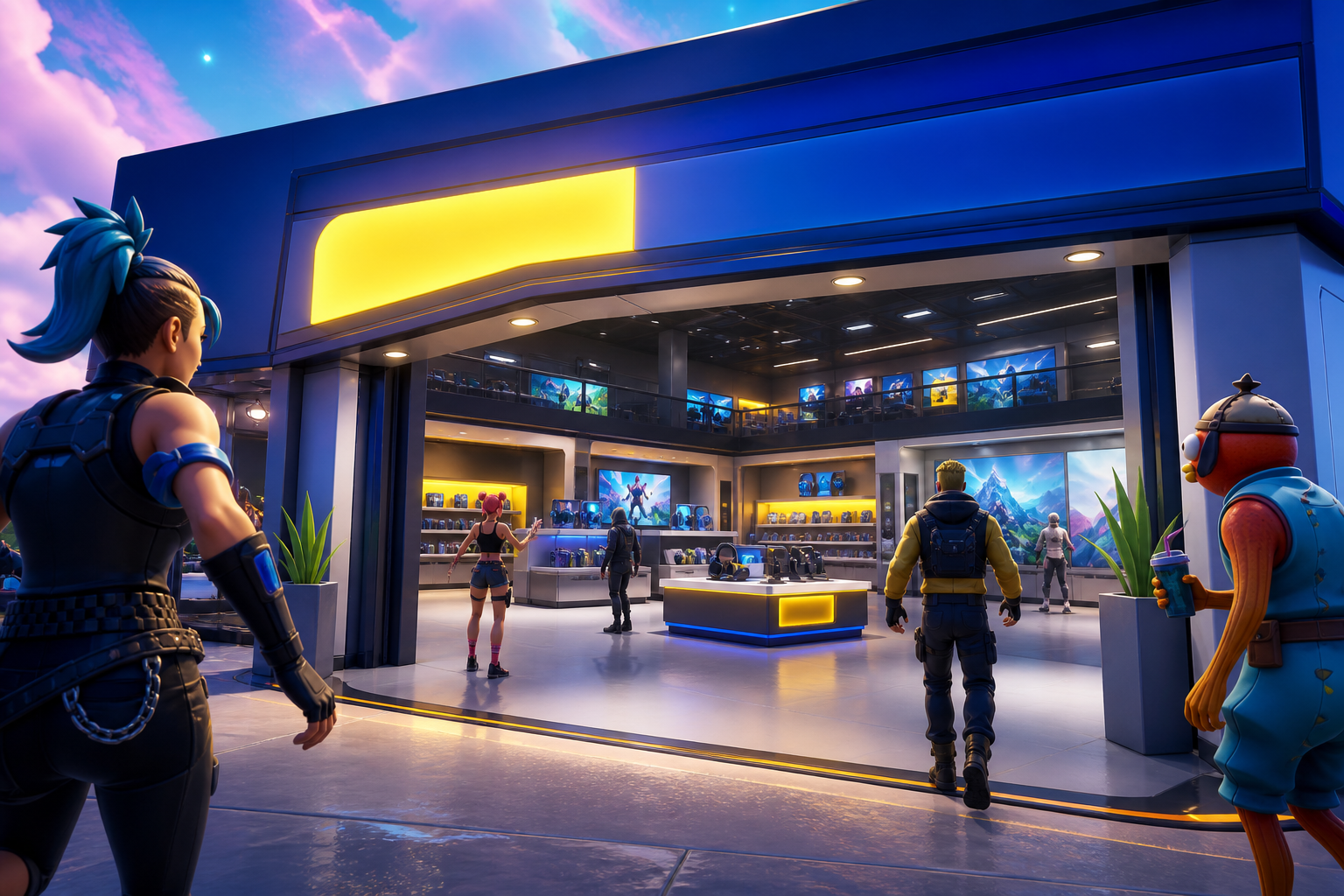
What you can do at Best Buy’s Fortnite store
Access Best Buy on Fortnite
Select Search and enter one of the island codes below to access Best Buy on Fortnite:
Drive City: 6246-3089-1172Meet Up (Proximity Chat): 3527-4959-6539
Toy Box: 9061-5458-7889
When commerce migrates from glass-and-steel to pixels, the choreography of shopping changes: it becomes a stroll, a sprint, a scavenger hunt. Best Buy’s new presence inside Fortnite—less a shop than a sculpted, playable showroom—casts retail in those shifting terms. The yellow-and-blue logo hangs where one expects a neon sign; beneath it, an island opens like an invitation, all ramps and escalators and display tables that one can cross in a single jump. You arrive as an avatar, which is to say you arrive both intimate and distanced: close enough to inspect a virtual laptop’s bezel, far enough to understand that the laptop itself is not the point.
Entering the store is, first and foremost, an act of navigation. The architects of the space, working in the curious grammar of Fortnite’s Creative mode, have translated department-store logic into game mechanics. There are aisles for consoles, a nest for audio, a ring of smart-home demos; each zone is a set piece, deliberately legible, a tableau meant to be read and played. Visitors can wander, but they can also be directed—through quests that reward emotes or cosmetic items, through timed events that drop a discount code into a player’s inventory, through a live schedule of product demos conducted by streamers or brand ambassadors. The experience is part catalog, part amusement park.
There are practical offerings embedded within the whimsy. In the console area, a player can step onto a platform and watch a brief trailer for an upcoming game, then test a controller-like gadget that responds to the avatar’s gestures. In the audio zone, spatialized sound effects are employed as both demonstration and lure: a pair of headphones causes a whisper to be audible only within a few feet, inviting intimacy in a medium that usually broadcasts broadly. Some displays act as bridges back to the physical world. Clicking the right object may open a purchase link in a browser, rode a virtual receipt into a real shopping cart. The transaction maintains its terrestrial signatures—a shipping address, a credit-card form—but the lead-up to the checkout reads like entertainment.
There are also delights that make commerce feel incidental. A series of mini-games—an obstacle course fashioned from oversized TV remotes, a timed repair puzzle that asks players to reattach circuits under pressure—engage the player’s reflexes and curiosity rather than their wallet. Completing these challenges can unlock skins or stickers, digital badges that carry no intrinsic value outside the game but that function, in this economy, as tokens of belonging. For teenagers who treat Fortnite as a social square, earning a Best Buy emote is as significant as owning a visible brand on one’s jacket.
Best Buy’s designers have been careful to make the store porous to audiences. There are spaces that encourage lingering: a demo theater where product announcements are projected across a curved screen; a stage that can host concerts or panels; a lounge where avatars gather and conversation, when it occurs, drifts like background music. These are the places where commerce recedes and spectacle takes over. Here, the brand is less a merchant than a host, a curatorial presence that seeks to generate association rather than to close an immediate sale.
And then there is the matter of exclusivity. Fortnite has become a labyrinth of limited drops and time-stamped collaborations, and Best Buy’s island participates in that logic. Limited-edition skins, branded back bling, and emotes tied to product launches turn the store into a theater for scarcity. The practical appeal is straightforward: if a cosmetic is obtainable only by visiting the store during a particular weekend, players will show up in droves, and anything they do while present—meet a streamer, enter a sweepstakes, click through to a product page—becomes valuable data.
That data is the point. Retail, evolved, is a conversation: the brand speaks in experiences, and the player replies with attention, time, and clicks. Best Buy’s island can be read as a sophisticated experiment in translating foot traffic into digital metrics: dwell time, social interactions, earned media. But it is also a cultural artifact, an example of how the contours of public life are being remade inside platforms that were conceived as games. Where a shopping mall once provided the architecture of adolescence and idle consumption, Fortnite now offers a comparable field—only flatter, more performative, and always subject to the logic of updates and seasonal rotations.
There are tensions, inevitably, between the spectacle and the sale. Critics will say that such spaces commodify play, that they convert the unstructured joy of multiplayer worlds into one more channel for targeted advertising. That critique is not false, but it is incomplete: the Best Buy island also supplies a certain utility. For many consumers, online shopping is abstract; seeing a product in context—visualizing a soundbar under a television, experiencing the scale of a monitor—resolves doubts that a static image or a spec sheet cannot. In this way, the virtual showroom performs an old function in a new register: it reduces uncertainty, and it does so with an architecture that rewards exploration.
Perhaps the most interesting question is less about efficacy than about style. What kind of public does this conjure? Who occupies it, and under what terms? If you are a parent, you might enter the store to click through a warranty plan while your child races past you on a neon scooter; if you are a teenager, you might stop for a concert and stay for the hunt for a rare skin; if you are a marketer, you might study the heat maps of attention as if they were a new kind of market research. The island accommodates all these intents with a certain shrug: it is, after all, a world built to be remade.
Visiting Best Buy in Fortnite is, finally, an encounter with a future that is already present. The gestures—test, click, collect, converse—are familiar, but they have been relocated, reimagined, and amplified. Retail, like play, has always been a social technology; what the virtual storefronts make plain is that the technology has changed. Whether those changes will be judged as improvement or intrusion depends, in part, on whether we remember that play and commerce have long shared the same stage, and whether we prefer to shop in silence or beneath the bright, insistent hum of a digital festival.
What to try first
- Explore the demo zones: test audio and visual products in situ to get a sense of scale and sound.
- Complete mini-games to unlock emotes and limited cosmetics.
- Attend live events for product drops, Q&A sessions, and streamer-hosted tours.
- Use the purchase links if you want to convert a virtual test into a real-world order.